Camp Kearns, 1942
- Aug 7, 2025
- 6 min read
Over time, a significant amount has been written about our history; however, there is little documentation to support these findings. This is what makes this collection valuable: the information I have collected comes from original pictures, letters, newspapers, and the memories of those who were at Kearns and served. I asked each person I spoke with what was important to them that I should not overlook. Where can I find information that supports your recollection of Kearns? These people were very supportive and would start their own research to develop information that would support their memories. Collectively, this is their research, their stories, and what they remembered about Camp Kearns during their time spent at Kearns. All these people are now gone. It would be a sad day if we lost our history now; it would be our own fault, and we would never get it back again.
On February 19, 1942, the American government had determined that the coastal American Japanese people were a threat to the safety of this country, and President Franklin D. Roosevelt signed Executive Order 9066, calling for the evacuation order to commence the round-up of 120,000 Americans of Japanese heritage to one of 10 internment camps that had been established further inland. They were officially called “Relocation Centers.” They housed more than 2/3 of the American Japanese people who were citizens of the United States. These people, all coastal residents, were housed in tarpaper-covered barracks of simple frame construction without plumbing or cooking facilities of any kind. One such place was located southwest of Camp Kearns.
The Rio Grande rail spur ran directly through Camp Kearns. The American Japanese people would always stop at Kearns on the way to the internment camps. When they arrived at Kearns, they were given food, water, and limited exercise. The young boys and men were offered jobs doing construction work while the base was under construction. The last official building constructed was the Base Headquarters, built by the Japanese people. After the work was completed, they were then sent off to join their families. They remained there until the development of the 442nd Regimental Combat Team, the only American Japanese unit during World War II.
The Special Operations unit arrived, a little more than a month before the rest of the men. This group consisted of men classified as non-combat-ready due to physical disabilities. This was a generation of people who had survived polo, with the aftermath of having physical challenges. The common side effects include blindness, having a glass eye, wearing braces on the legs, loss of an arm, and the inability to bend and move items from one place to another. The one thing they all had in common was that they had all been shipped to the Army Air Base from the East Coast.
Everyone arrived at the base by train. This was a shipment of men carried in three carloads, with 260 seats per car. All of them arrived during the same shipment, a few days earlier than expected, with only a couple of hours of sunlight left, and none of the barracks were completed.
As they disembarked the train, they were instructed by the Sergeants, "to walk around to the other side of the train station, to the side of the building where tents were located, pick up a tent, and meet for further instructions in front of the train station". There were 780 men altogether, and only three Sergeants. As they all stood and listened to directions, the wind picked up. In the distance, a huge cloud of dust was spotted. The soldiers stood and listened, watching as the huge cloud drew closer. They followed instructions to pair up with the person next to them and to start setting up the tents on the side of the barracks. The longer the instructions carried on, the larger this dark cloud was becoming, growing in shape and size.
Finally, they were instructed to proceed to the assigned block and begin setting up their tents and gear inside. “You never saw such a large group of soldiers run so fast as you had then. That tornado was coming right at us, and we knew the speed that it was traveling; it was going to be a large one". The wind picked up, and the cloud got closer, just when it was almost upon us, someone yelled out, “Take cover, NOW!” We all dropped what we were doing and ran to the closest barrack and crawled under the unfinished barrack floor space. It suddenly became very bright, and all sorts of tornado alarms began to sound. Then came voices calling out –“Hey, where is everyone. We are from Fort Douglas; we have come to help.” One by one, we slowly emerged from under the barracks, scared as could be. The Sergeants all met up, while the others started to assist us in setting up our tents and gear. After we had established ourselves in this new environment, it was explained to us that tornadoes were very rare in Utah, largely due to the protection provided by the two mountain ranges. Over dinner, we also learned that there was only one way into the base at that time, and it was all dirt roads, extending from Redwood Road to the base. Oddly enough, we also beat the food train, and it was expected in another two to three weeks. Until then, Fort Douglas would be delivering the food twice a day.

For two weeks, they brought food and supplies for those at the new base. Early every morning, they would bring breakfast, typically consisting of hot coffee, scrambled eggs, and fruit. Lunch was always cold sandwiches, drinks, and cookies. Dinner was always macaroni and cheese, some sort of meat, and fruit. The first indoor mess hall was built nearby on Block 11, adjacent to this outdoor mess hall. This was the first block to be completed and where the Special Operations were housed.
Designated first as an Overseas Replacement Training Center and later as a Replacement Depot, Overseas Replacement Depot No. 2 at Kearns, Utah, was an outgrowth of Basic Training Center No. 5.
The facilities at the Center, which had been operated by the Training Command of the Army Air Forces since July 20, 1942, were transferred to the Second Air Force on October 1, 1943. However, the Training Command maintained a transitional Overseas Replacement Training Center as a separate installation at Kearns. The Overseas Replacement Training Center (ORTC) was placed under the jurisdiction of the Second Air Force for post-administration but remained under the Army Air Forces Western Technical Training Command for all other administrative and training purposes. Many of the personnel, both officers and enlisted men, who had aided in the operation of Basic Training Center No. 5, were transferred to the new Overseas Replacement Training Center.
Authorized strength of the Overseas Center was 100 officers and 1401 enlisted men. After seven organizations were reduced to one officer and one enlisted member each, the Overseas Centers consisted of a headquarters squadron, a guard squadron, and the Air Force band, two training wings, and an Ordnance detachment. Each training wing was established to comprise a headquarters detachment, mess squadron, and four training groups. The entire Overseas Replacement Training Center was housed in eight blocks. The headquarters of the Center was established in a building once used by the Corps of Engineers as an office during the construction period of the Basic Training Center No. 5. Many of the departmental offices were located in the barracks buildings that had previously served as offices when the basic training center was in its infancy.
The dust factor had created many health issues for the men. The wind blew all the time, and when it was a hard wind, it made it impossible for the men to breathe. Being out in the harsh wind would scrape away any unprotected flesh; often, it would reopen throughout the week, allowing the men to contract infections that sometimes required hospitalization. Upper respiratory infections were also another one that was a problem and kept the hospital beds full. Due to the massive health issues, the men were finally allowed to wear their gas masks during such windstorms.

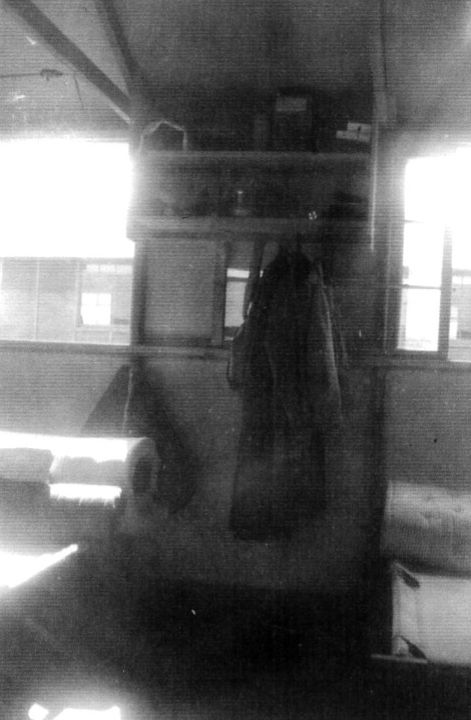
Each barrack had three strategically placed potbellied stoves that were mounted in a box of sand. Soft black coal from Price, Utah, was the usual fuel for the stoves. This was of very poor quality, soft coal that turned to “clinkers” within a matter of hours. To keep the stoves working, it was necessary to let them die down and cool so the “clinker” could be removed. Inside the tarpaper barracks were two rows of beds. Above every other bed, there was a large window that was improperly sealed. They opened downward and inside from the top. The wind blew sand that would filter through the windows and onto the beds, as well as through the clothing. When it rained, the floors soon turned into mud. When it snowed at night, the soldiers always awoke with red snow piled on them. The latrines and showers were combined and were rather large, equipped to accommodate up to half a block of men. This meant that there were six hundred to nine hundred men who all wanted showers at the same time as you did. Each latrine had only fifteen shower stalls. By the time the men had finished with their showers, those in waiting had the ultimate pleasure of a steam bath first.