Kearns Historical Society
The history of Kearns, Utah, has been a mystical journey; for the past seventy-six years, urban legends and myths have been formed to entertain us as our small community developed. The legendary utopia seemed to romanticize the community with the idealism of what we thought living at Camp Kearns was like. Stories of those whom this small community called their heroes began to evolve about the men and women of Camp Kearns. The Imperative memories from parents who had witnessed World War II and even had vivid memories of Camp Kearns were passed down to their children.
It’s been seventy-six years since the gates closed on November 26, 1946, and we would be shocked to really know just how many of those men and women had proudly brought their families back to Kearns, out of curiosity as to what had happened to the old place. Flabbergasted by the transformation from an overseas replacement depot to an intelligently planned civilization, a community now called Kearns.
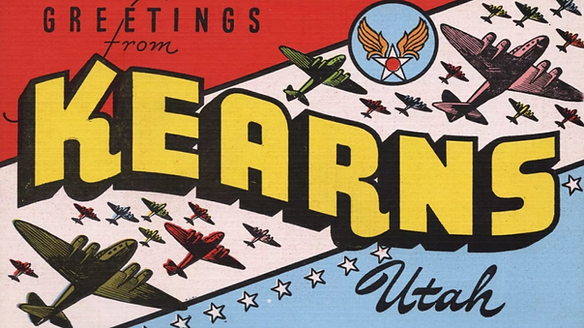
Our history, like that of most other communities in Utah, cannot be traced back to the Mormon Pioneers. Some pioneers came to the Kearns area but quickly left when the wind blew away their crops in mid-season. The land was left untouched for another 50 years, after which some farmers decided to cultivate it. Trying out a new form of farming called “Dry Farms”, the land was farmed with wheat and barley fields for almost another fifty years. In 1942, when the land was bought by the U.S. Government. At that point, the wheat fields and wasteland had blossomed into Utah's third-largest community in the form of a World War II Army Air Base. When the gates opened to the newly formed military base, very little information escaped as to what was being done.
In short, the base was a temporary one; all structures built were designed to last at most only seven years. The young soldiers came to Kearns during very difficult times and did not like or enjoy being there, nor did they embrace the reasons why. Their country was under attack, as were their freedoms and their families.
_edited.jpg)
_edited.jpg)
Conditions in the early days were rugged. It was a dusty desert landscape, made even more desolate by the rumbling of steam shovels, road plows, and thousands of trucks. The weather conditions were unfriendly, and dust flew about, covering soldiers from head to foot with grimy and gritty dirt. It flittered into their barracks through the cracks in the roofs and walls, and rolled about, covering the floors and beds, and into their boots, covering their clothes to the bottom of their mess kits. The rain pelted them through the nights, and red snow piled on them while they slept. Cleanup had to take place immediately, regardless of the time of day or night.
Bottom line was that Kearns was a modern military plant, a thriving “soldier factory” that was turning young boys into killing machines. It was not an easy way of life, but it was necessary to train the soldiers to outfight, outshoot, outmaneuver, and outthink their enemies. And in the end, that mission was accomplished.
After the war ended, the base was closed in 1946, and the military completely left the area, taking all records and papers with them. Those documents were sealed. Left were over 100 structures and memories from those who worked and were stationed at Kearns, and the many women who came to the base to dance with the soldiers. History basically had remained lost and forgotten for almost 65 years.
In 1997, those records were still sealed when I established the Kearns Historical Society. I started out with no knowledge about the base; there was no map to follow, no book had ever been written about how to search for a lost history. Without a name or any other information, I had no starting point, except for the knowledge of the July 12, 1973, warehouse fire in St. Louis, Missouri. This disastrous fire had destroyed approximately 16-18 million official military records, and, with my luck, that is where our community history would be found up in smoke.
After searching for information before 1997, I discovered a medical yearbook that listed names. I looked them up and called those still alive, asking if they remembered anything about Camp Kearns. This led me to the family of Col. Waldon Doe. He had passed away, but his son was still living and had been stationed at Kearns. The family kindly let me borrow their scrapbook so I could scan it. Inside, I found a crucial piece: the official history of Kearns had been compiled since the base opened and was kept updated daily until the last soldier left. These records, written by the men of Camp Kearns, cover nine volumes. After six months of searching, I found them, still marked as “Restricted,” and essentially closed to the public. I contacted Senator Orin Hatch, who helped get them reclassified. The records contain valuable historical information—including reports, orders, photographs, and letters—that eventually became part of the official AAF records. Costing $260 a roll, I could only afford eight rolls of microfilm, but that was enough for now. This allowed me to locate many more people and establish the Historical Society. It was enough that three other groups came back to Utah just to hear what Camp Kearns was all about.
Kearns first opened as a basic training base known as the Salt Lake Army Air Force Base; it changed names and destinations several times before being officially designated as Camp Kearns. Through my research, I have discovered that our history has finally come home, a remarkable achievement. However, to know that it has been achieved through the efforts of just one person, locating the men and women of Camp Kearns, is truly a miracle. But none of this has been a waste of time. In 2011, the 801st came back to Kearns for their last official reunion. Only 15 of them were still living at the time. Within 4 months, they had lost another five men, and by the end of the year, the group historian had passed. I often call them the spies who loved us; most of them had trained at Kearns as individuals. The president of the group was among the first units out of Berkeley sent to Kearns. Taken aback by seeing a church out in the middle of nowhere, he took a picture of a lonely church. They brought with them a treasure trove of items. It was his picture that was used as the cover page when I wrote the proposal and saved the chapel in Copperton, which was Camp Kearns Chapel, located on block 13. It was through Col. Walter Sigmund's scrapbook that I was able to locate a Utah family who had been in search of a brother shot down and listed KIA. For 60 years, his brother had been looking for his remains; finally, that book was closed. Camp Kearns men came out to help locate items, bringing information with them. The last enlisted post engineer, two men sent here for training, had been here twice. The last man to lock the main gate was living here in Salt Lake City. Many local people also made themselves known, including a pinup girl, secretaries, bookkeepers, the shoe repairman, the barbershop owner, and the PX girls. I can’t forget the many civilian workers from the area, better known as the volunteers, the ladies who ran the daycare, the ones at the hospital gift shop, the aids at the hospital, and the young ladies who were bused into Kearns to dance with the lonely soldiers. I talked for hours on the phone with the greats like Shirley Temple, Charles Bronson, and Tony Bennett, just to name a few. Each year that we held the Museum for a Day, people from all over came for a visit, sons and daughters of those who had served at Kearns, Hap Heilronn, the only survivor of the Rover Boys, the Berlin Candy Bomber, Col. Halverson, grandson, and great-grandsons of Senator Thomas Kearns. My research has taken me to eight different countries: England, Scotland, Ireland, the Netherlands, Germany, Italy, Poland, and Russia.